Neighborhood·Updated September 8, 2026
Little Valley Home Values: Why It Prices Above the Rest of St. George
Bigger lots, newer homes, horse zoning inside the city limits, Dixie Power rates, and the Desert Hills school pipeline. What each one does to the number, and where an automated estimate loses the thread.
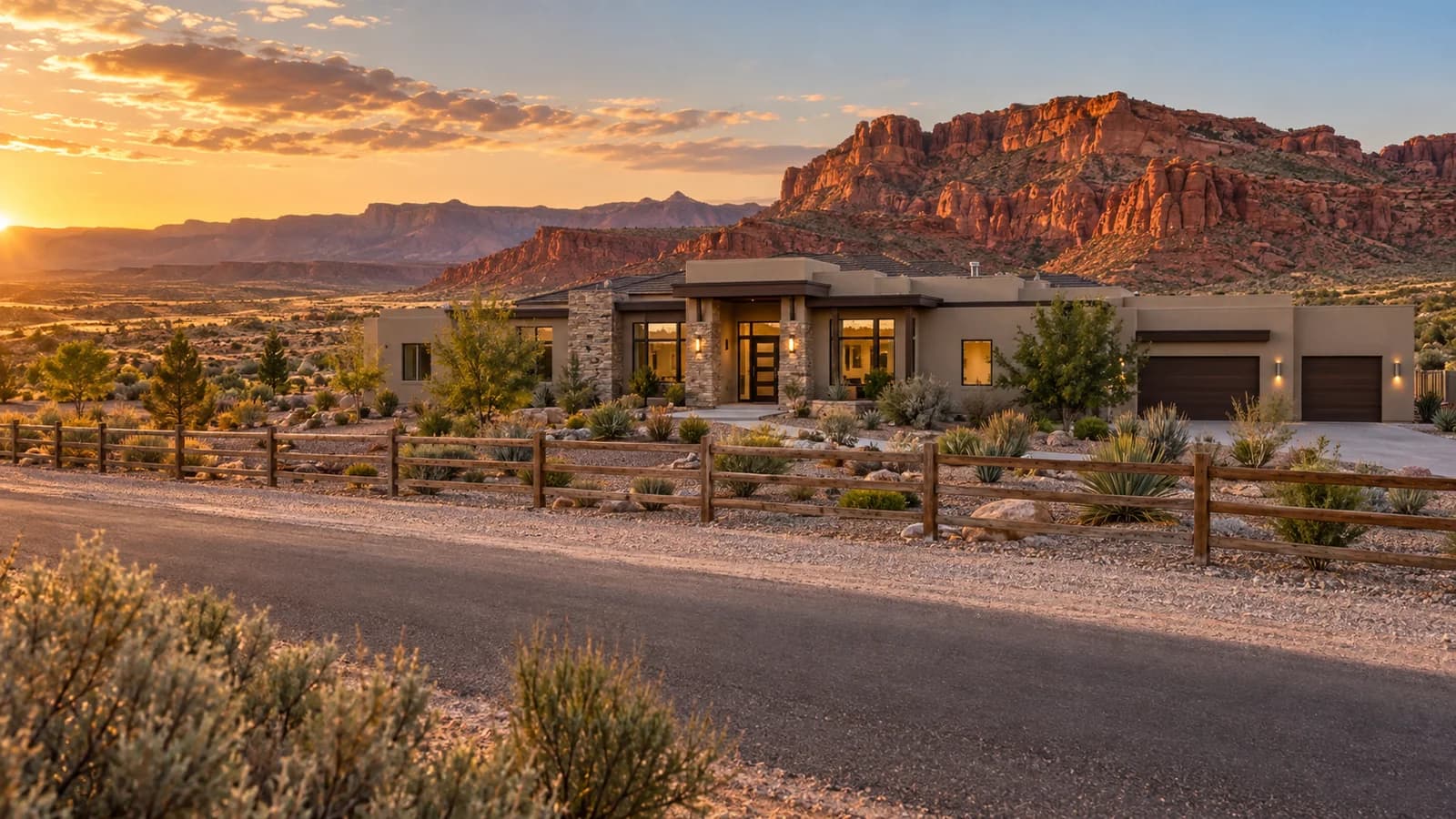
Want your own number instead of a market average?
Check my home’s value →Little Valley is the southeast corner of St. George proper: east of River Road, strung along Little Valley Road and 3000 East, with Washington Fields across the city line to the east and the airport mesa rising to the southeast. Twenty years ago most of it was hay fields and horse pasture, and older locals still lump it in with “the fields.” Today it’s the neighborhood families moving to St. George ask for by name, and that demand is the main reason homes here price above the rest of the city.
A patchwork, not a master plan
There’s no single developer behind Little Valley. It went in one subdivision at a time, mostly from the early 2000s on, with S&S Homes, Salisbury Homes, and Ence Homes among the builders, and new phases are still being platted. So the names on the plat maps matter more here than they would in a planned community. Fieldstone, the Knolls at Little Valley, the Cove at Little Valley, Meadow Valley Farms, and Crimson Vistas are builder subdivisions on city lots, larger than the lots in older St. George but still lots. Then there’s the ring of acreage toward the fields: Little Valley Ranchos, Little Valley Ranch Estates, Rancho Verde Estates, Sun Valley Estates, Tupelo Estates, and Mulberry Estates, where parcels run an acre and up and many are zoned for horses.
That mix is the first thing to understand about value here. A 2016 single story on a quarter acre builder lot and an acre with a barn and a dirt equestrian shoulder along Little Valley Road can be a few blocks apart, and they’re completely different products. Any number that averages them together, and most automated estimates do, isn’t telling you much about either one.
What families are paying for
Schools, first. Little Valley Elementary sits on Horseman Park Drive, and most of the neighborhood feeds Sunrise Ridge Intermediate, then Desert Hills Middle and Desert Hills High, which opened in 2008 to serve the south side and draws from Bloomington and Bloomington Hills as well. Buyers relocating from Utah County or Las Vegas with kids tend to start their search with that zone and work backward to a street. It’s worth confirming the assignment for a specific address with the district’s boundary tool rather than assuming.
Then the parks, which are a real draw rather than a line in a listing. The Fields at Little Valley is a full multi sport complex with a splash pad, and the Little Valley Pickleball Complex on the same ground is one of the largest public pickleball facilities in Utah, two dozen lit courts that host tournaments. Add wide section line roads, newer homes with RV garages and casitas, and a ten minute run up River Road to downtown, and you have the checklist a lot of buyers from out of state show up with.
Then the power bill, which locals bring up before anyone from out of state would think to ask. Little Valley sits south of the Virgin River, and St. George homes on that side of the river are served by Dixie Power, the member owned cooperative, rather than the city’s own utility. Dixie charges a flat rate per kilowatt hour and a higher monthly service charge, so on a light winter bill the two come out about even. Summer is where they separate. On a 2,000 kilowatt hour month, typical for a house running the air conditioner from late spring into October, Dixie came in about $36 under St. George City power and $88 under Washington City power as of August 2026, and on a 4,580 kilowatt hour July bill from a large home the gap with the city was $116. Buyers coming from the north side of the river know this, it shows up in listing remarks, and it’s part of why a Little Valley home holds its price against a comparable house in the city’s power territory. A national model has no field for which meter is on the wall.
Where the numbers sit
Little Valley prices above the St. George median, and not by a little. As of early September 2026, about a hundred homes and condos were active or pending across the neighborhood at a median asking price near $838,000. Closed sales over the past year or so have mostly landed between the high $600,000s and the mid $900,000s, depending on the month and on where you draw the boundary. Typical single family resales start in the $500,000s. Acreage and the larger custom homes clear $1 million.
Two cautions on those figures. Asking isn’t sold, and with the typical seller getting a few percent under list, sold medians run below listing medians. And the boundary question is bigger here than in most neighborhoods. Some data providers fold Bloomington Hills South and the Knolls into “Little Valley,” which pulls the average down, while others count only the newer subdivisions out toward the fields, which pushes it up. Ask which map a number is drawn on before you lean on it.
What moves the number on your lot
- Lot size and what it’s zoned for. A quarter acre and an acre aren’t on the same price curve, and an acre that’s actually zoned for horses is worth more to the buyers who want one than an acre that isn’t. Check the zoning before anyone quotes you a per acre number.
- RV garage, casita, shop. The newer product here leans single story with a deep RV bay, and buyers arriving with a trailer and a side by side pay for it. A home without one is being compared against neighbors that have it.
- Phase and age. A 2004 home in an early subdivision and a 2023 home two streets over are different comps. Newer phases also mean the builder is still your competition, the same pressure Washington Fields sellers face.
- The complex next door. Tournament weekends at the Fields bring traffic and street parking. Some buyers pay to be within walking distance, some pay to be a few blocks away, and a model doesn’t know which street it’s pricing.
- Which side of the city line. Little Valley is inside St. George, so a home here pays St. George property tax and is on city water and sewer. The same kind of home a mile east in Washington Fields sits in Washington City, with its own rates for both. Electricity is the exception: both sides of that line are Dixie Power, so the line that matters for the power bill is the river, not the city boundary. Comps pulled across the city line still aren’t quite apples to apples.
Why estimates wobble here
Utah doesn’t publish sale prices, so a national model is already working from listing data and county records that were never meant to capture any of the above. Little Valley makes that harder than most places: a patchwork of subdivisions with no master plan, horse acreage sharing a ZIP with condos, and a chunk of the housing stock young enough that its only prior sale was from the builder. That’s a recipe for a wide, hedged range. A useful number for a Little Valley home starts from your subdivision, your lot, and what’s listing and closing on your side of Little Valley Road.
What's your Little Valley home worth right now?
A free range built from recent activity in your part of Little Valley, not a citywide average that blends horse acreage with condos.
Get your Little Valley home's range